

Quick answer
The main places in Paro are Tiger's Nest (Taktsang), Rinpung Dzong, the National Museum, Kyichu Lhakhang and the drive to Chele La pass. Two full days covers the town and the Tiger's Nest hike, and a third day can go to Haa Valley or Dzongdrakha. Indians don't need a visa, a passport or Voter ID is enough, plus the SDF of ₹1,200 per person per night.
We plan Bhutan trips for Indian families, couples and college groups, and most of them fly into Paro. The common mistakes are trying to do everything in one afternoon, or reaching a temple just after it has shut for lunch. This is the list we give our own clients, with drive time from Paro town, fees, opening hours and the small things that go wrong.
On fees: Bhutan has changed its monument fees more than once since 2022. The Nu figures below are the latest published ones, your guide will confirm at the gate, so don't argue over small differences. The ngultrum is pegged 1:1 to the rupee, so Nu 500 is ₹500.
Places to visit in Paro town
Most of the places in this section are within about 5 km of the main street. One day is enough for all of them, with a long lunch break in between.
1. Rinpung Dzong (Paro Dzong)
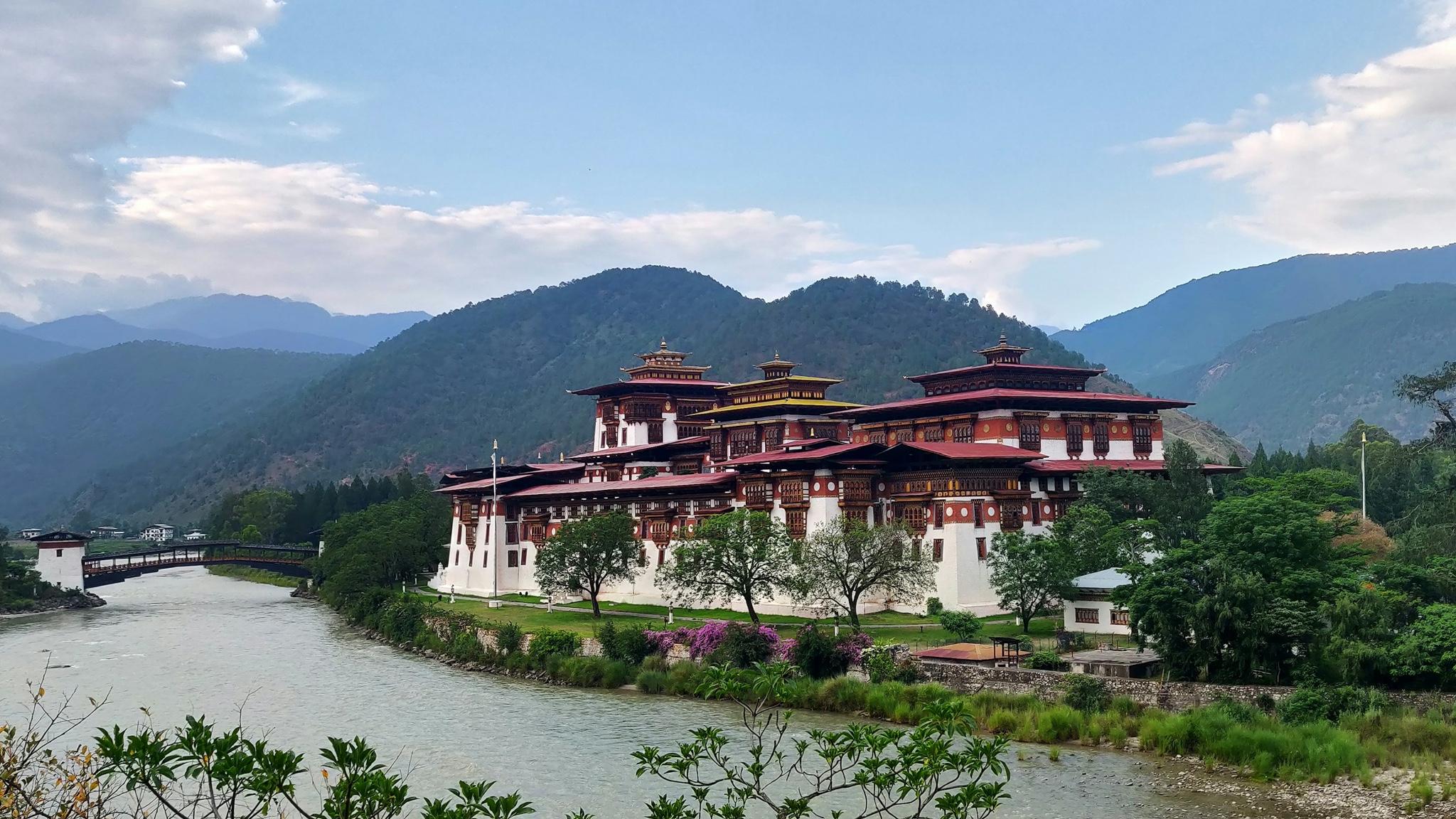
About 1 km from town, ten minutes on foot across the river.
This is the large fortress you see from the plane when you land. It is still in use, it is the district administrative office and a monastic body lives there, so some parts are closed to visitors and the whole dzong closes when officials need it. Enter over Nyamai Zam, the old wooden cantilever bridge, not from the road side. The walk up from the bridge is short but steep.
Keep one hour. The published fee is Nu 500 for adults and half that for children aged 5 to 17.
Dress code: full sleeves, long pants or long skirt, no shorts, no cap inside. The guide will check you before you go in, and men in half sleeves get stopped at the door quite often, so keep a full-sleeve shirt in the bag even if it's warm. No photos inside the temple rooms, courtyard photos are ok.
Paro Tshechu (the big festival) happens at this dzong in late March or early April. 2026 dates were 29 March to 2 April, for 2027 the listed dates are 18-22 March but it goes by the lunar calendar so confirm again before you book flights. Paro hotels get full months before Tshechu, so if you want those dates, book early.
2. National Museum of Bhutan (Ta Dzong)
1 km uphill from town, 5 minutes by car. It's in the old watchtower right above Rinpung Dzong. Open 9 am to 5 pm, closed on government and local holidays, ticket counter shuts at 4. Fee Nu 500 for tourists. Students, monks and nuns go free, so college kids should carry their ID card, that's ₹500 saved per head. Keep 1 to 1.5 hours, most people spend the most time in the masks section.
Tip: do the museum first and then walk down the footpath to the dzong. Downhill is easier on the knees, and the driver comes round by road and waits for you at the bridge. You skip one steep climb that way.
3. Zuri Dzong walk
Trail starts near the museum, around 1 km from the main street. Zuri is a small dzong on the ridge above, and from the trail you see the whole valley and the airstrip. About an hour up and back, easy pace. Mostly you can't go inside, you go for the walk. Hardly any tourists do this one.
We use it on day one as a test for Tiger's Nest. If someone is getting breathless on this trail, book them a pony for the first half of Taktsang, lots of people do that.
4. Kyichu Lhakhang
4-5 km north of town on the Drukgyel road, 10 minutes drive. 7th century, one of the oldest temples in Bhutan, small compared to the dzongs. Local families come every day for butter lamps and prayers so it's a working temple, keep voices low and stand where the guide tells you.
Timings 9 am to 12 and 1 pm to 5 pm. If you land up at 12:15 you'll be standing outside for 45 minutes, so plan lunch around it. Fee Nu 500 as per the chart. 30-45 minutes is enough. Drukgyel Dzong is further up the same road, club both together.
5. Dungtse Lhakhang
About 1 km from the main street. Three-storey temple in the shape of a chorten, paintings get more detailed as you go up. Ladders between floors are steep and narrow, elderly people and anyone with knee issues better stay on the ground floor. Fee listed at Nu 500. It's locked a lot of the time, so ask the guide to check the caretaker is there before driving over.
6. Paro town, the weekend market and the archery ground
Main street is about two blocks. Wooden shops, a few decent cafés, handicraft shops for kira, gho, prayer flags and thangka prints. Weekend market is near the river, locals buy chillies, red rice and dried yak cheese. The yak cheese is rock hard, you chew one piece for a long time, so try before you buy a whole packet. Go in the morning, by afternoon the good stalls are gone.
If there's an archery match going on at the ground, stop. It's the national sport, targets are much further than what we use in India, and the team sings and dances every time someone hits. Free to watch.
Most shops and hotels in Paro accept Indian rupees because of the peg. Keep smaller notes. Shopkeepers often return change in ngultrum, and ngultrum is not accepted back in India, so spend it before you leave or ask for change in rupees.
7. Paro Airport viewpoint
About 3 km from town, on the road above the runway.
The runway is in a narrow valley with ridges on both sides, and only specially trained pilots are certified to land here. The roadside viewpoint looks straight down the runway. Ask your guide for that day's Drukair and Bhutan Airlines arrival times and reach 15 minutes before. Most landings are in the morning.
Keep 20 minutes plus waiting time for the flight. No fee.
Day trips and short drives from Paro
The places below are spread across the Paro valley and beyond. You need a car and a guide for all of them, you will have both anyway because that is how tourism in Bhutan is set up.
8. Tiger's Nest Monastery (Paro Taktsang)
About 10 to 12 km from town to the Ramthangkha trailhead, 20 to 30 minutes by car.
This is the main reason most people visit Paro. The monastery is on a cliff about 900 m above the valley floor. There is no road, you walk up, or ride a pony for part of the way.
Reach the trailhead by 8 am. Starting much earlier is not usually allowed, and starting late means coming down in the midday sun, which is tiring. Most people take 5 to 6 hours for the round trip, including time inside. Fit people do it in about 4 hours. Some families take 7. All of these are normal, nobody is timing you.
After 1 to 1.5 hours of walking, at about 2,950 m, there is a cafeteria with tea and a toilet. This is the first point where you can see the monastery across the gorge. Ponies go from the base up to the cafeteria only. After that everyone walks. Past the cafeteria there is a long section of steps that go down and then back up before the monastery gate, this last part is the hardest.
Other points:
- The published fee for Taktsang is Nu 1,000 for adults and Nu 500 for ages 5 to 17. These rates have changed several times since 2022, so we check them again before every trip.
- Walking sticks are rented at the base for around Nu 50. Take one, it helps a lot on the way down.
- Phones and bags go into lockers before you enter the temple rooms.
- The dress code is the same as the dzong. You will probably walk up in a T-shirt because it gets warm, so carry a full-sleeve layer in your daypack for the temple.
- Carry water, a snack, sunscreen and a cap for the trail. Wear shoes with grip, not new shoes.
We always put Taktsang on the last full day in Bhutan, not the first. Two or three days at altitude before the hike makes the climb easier on the lungs. If it rains heavily on the planned day, you still have a spare day to shift it.
9. Drukgyel Dzong
About 14 km north of town, half an hour beyond Kyichu Lhakhang.
It was built to guard the old route into Tibet. A fire in 1951 destroyed it and it stayed in ruins for decades. Restoration started in 2016 and the rebuilt dzong now stands at the head of the valley. On a clear day the snow peak of Jomolhari is visible behind it.
Keep 45 minutes to an hour. Do it with Kyichu Lhakhang on the same drive. If you are short on time, skip Drukgyel and keep Kyichu.
10. Tachog Lhakhang and the iron chain bridge
About 11 km on the Paro to Thimphu highway, roughly 20 minutes.
A private temple on the other side of the Paro Chhu. You reach it on foot over a bridge rebuilt in the old iron-chain style. The bridge moves when people walk on it. Children usually enjoy it, some elderly people prefer not to cross, which is fine, you can see it from the road side too.
No separate planning needed. It is on the way to Thimphu, so ask your driver to stop for 20 to 30 minutes when you leave Paro or when you come back. Morning light is better for photos.
11. Dzongdrakha
20 minutes by car towards Bondey, then a 30 to 40 minute walk up through pine forest.
A group of shrines built on a cliff, above farmhouses and paddy terraces. It is a smaller and much easier version of Tiger's Nest. Very few tourists come here.
Keep 2 hours in total including the drive. Good for grandparents who cannot do Taktsang, or as an easy morning the day after the Tiger's Nest hike when your legs are sore.
12. Chele La Pass
About 35 km on the Bondey to Haa road. Budget 1.5 to 2 hours each way.
At 3,988 m it is the highest motorable pass in Bhutan. There are prayer flags all along the top, and on a clear morning you can see the Jomolhari range to the north. The road is narrow and steep, with many hairpin bends, and the last stretch is rough in parts. If anyone in your group gets carsick, give them a tablet before leaving the hotel, not halfway up.
Leave by 7 am. Clouds come in by late morning almost every day, and after that there is mostly fog at the top.
From December to February the road can close after snowfall. At almost 4,000 m it is cold throughout the year, so carry a down jacket, a woollen cap and gloves even in May. People usually spend 30 to 45 minutes at the top. If you want to walk up the ridge, add about two hours. Anyone with breathing problems or blood pressure issues should not walk fast or climb at this height, check with your doctor before the trip.
13. Haa Valley
About 60 to 65 km via Chele La, 2.5 to 3 hours each way.
Haa has fewer hotels and more farmhouses than Paro. The two main temples are Lhakhang Karpo and Lhakhang Nagpo, the White Temple and the Black Temple. As a day trip it is a long day in the car. If your itinerary has room, stay one night at a farmstay in Haa instead.
Permit: your regular Bhutan entry permit covers Paro and Thimphu only. Haa needs a separate route permit. It is free and we arrange it before you leave, but don't leave Paro without it, there is a checkpoint on the way and you will be sent back.
How to get to Paro from India
By air. Paro has Bhutan's only international airport. Drukair flies daily from Delhi, about 2 hours 20 minutes. Kolkata has around four flights a week, about 90 minutes. Bagdogra and Guwahati have fewer, around two a week each, both under an hour. Bhutan Airlines also flies some Indian routes. In April and October seats sell out early, so book flights as soon as your dates are fixed.
By road. Most budget travellers from Bengal, Bihar and the Northeast come this way, through Phuentsholing. Reach Bagdogra or New Jalpaiguri, then it is about 4 hours by car to Jaigaon on the Indian side. You walk across the border into Phuentsholing and get your entry permit at the immigration office there. From Phuentsholing to Paro is 160 to 165 km, 5 to 6 hours on mountain roads, so most people stay one night in Phuentsholing or Thimphu on the way instead of doing it in one go.
Documents. No visa for Indians. You need an Indian passport with at least six months' validity left, or your Voter ID card. Aadhaar, PAN and driving licence are not accepted. Children under 18 should carry a birth certificate, and school ID if they are in school. The entry permit is free, issued at Paro airport on arrival or at the Phuentsholing immigration office. You can also apply online in advance, which saves time at the counter in peak season.
SDF (Sustainable Development Fee). For Indian citizens it is ₹1,200 per person per night. Children aged 6 to 12 pay half, under 6 pay nothing. You can pay it online with the permit application, in cash at the entry point, or through your tour operator. In our packages it is already included.
Best time to visit Paro
There are two good seasons.
March to May is spring. Rhododendrons flower on the higher slopes, days are pleasant, and Paro Tshechu falls in this period. Mornings are still cold, so pack a jacket.
Late September to November is the season we recommend most. The monsoon is over, the sky is clear, and this is when you get the best mountain views from Chele La and the Taktsang trail. October is crowded and prices are at their highest, so book early.
June to August is monsoon. Green valley, fewer tourists, but slippery trails and the peaks are in cloud most days. December to February is cold and dry, many clear days, but Chele La can shut after snow and Paro nights go below zero. Pack thermals, a heavy jacket and gloves, a hoodie won't do. Hotels are cheaper in winter.
A sample 2-day Paro itinerary
This assumes you've already done a night or two in Thimphu, so you're used to the altitude.
Day 1, valley and town: Leave for Chele La at 7, back down by about 11. Lunch in town 11:30. Kyichu Lhakhang at 1 when it opens after lunch. 2:30 up to the museum, walk down to Rinpung Dzong, out over Nyamai Zam. 5 pm main street, tea, early dinner, early sleep because tomorrow starts 6:30.
Day 2, Tiger's Nest: Breakfast 6:30, ask the hotel for a packed snack. Leave 7:30, start walking at 8. Back at the base between 1:30 and 2:30 depending on speed. Evening, hot stone bath at a farmhouse, lots of farmhouses in Paro do it and it really helps the legs. Tell your guide in the morning so they book it.
Third day? Dzongdrakha in the morning, Drukgyel after lunch. Or swap the Chele La drive on Day 1 for a full day in Haa.
Ready to go? See our Short Bhutan Escape 3N/4D from ₹19,000 or the Bhutan Highlights 5N/6D from ₹41,999.
Plan it with us
Trips we run in Bhutan
Hotels, transfers, permits and a local guide, priced in rupees.

Frequently asked questions
How many days are enough for Paro?
Minimum two full days, one for town and one for Tiger's Nest. Three days lets you add Chele La or Dzongdrakha without rushing. Most Indians do Paro with Thimphu, many add Punakha also.
Is Tiger's Nest hike difficult for beginners?
Moderate, not technical. The path is clear and many people walk it every day. The difficulty is the altitude and the steps near the end. If you can walk 30 minutes daily at home, you can do it. If you are unsure, take a pony up to the cafeteria and walk slowly after that.
Do Indians need a passport to visit Paro?
No, a Voter ID also works. If you have a valid passport, carry it anyway. Processing at the airport is faster with a passport, and it covers you if plans change during the trip.
What is the SDF for Indians in 2026?
₹1,200 per person per night. Children from 6 to 12 pay ₹600, under 6 is free.
Can I use Indian rupees in Paro?
Yes, at most shops, hotels and restaurants, because of the peg. Cards are not reliable outside hotels. Carry enough cash in smaller notes.
How far is Thimphu from Paro?
About 50 to 55 km, 1 to 1.5 hours by road. Many people fly into Paro, drive straight to Thimphu, then come back to Paro at the end so Tiger's Nest is on the last day.
Can I visit Haa Valley from Paro on the same permit?
No. Haa needs a separate route permit. It is free, and a licensed operator arranges it before you go.
What should I wear to dzongs and temples?
Full sleeves and long trousers or skirts, for both men and women. No shorts, no caps, nothing sleeveless. Remove your shoes wherever your guide tells you to.
Want this trip planned for you?
Tell us your dates and who's travelling. A MyTripLama planner sends a day-by-day plan and a price, usually the same day.
Sources we checked
- Windhorse Tours: SDF for Indians
- Windhorse Tours: monument entrance fees
- National Museum of Bhutan: visiting hours and fees
- Holidify: Paro sightseeing
- Chele La Pass
Timings, fees and permits change. Confirm the latest with the venue or your MyTripLama planner before you travel.